
10 Fascinating Facts About Dolpa, Nepal You Need to Know Before You Visit
Nepal’s largest and most remote district hides a world frozen in time — turquoise lakes, snow leopards, ancient kingdoms, and a culture unchanged for centuries.
Tucked deep in the northwestern Himalayas, Dolpa (also spelled Dolpo) is Nepal’s largest district by area — yet one of its most mysterious and least visited. Whether you’re planning a trek, a pilgrimage, or simply a journey unlike any other, understanding what makes Dolpa special is your first step. Here are 10 extraordinary facts that will make you want to visit — and why staying at Hotel Murmur in Dunai makes the perfect base.
Dolpa Is Nepal’s Largest District — Yet One of Its Least Populated

The vast, untouched landscape of Dolpa District, Karnali Province, Nepal
Dolpa District covers 7,889 square kilometres — about 5.36% of Nepal’s entire landmass. Yet only around 43,000 people call it home. This extreme sparseness is what preserves Dolpa’s raw, untouched beauty. You can trek for days without passing another soul, surrounded by nothing but towering peaks, ancient valleys, and the silence of the high Himalayas.
Phoksundo Lake Is the Deepest Lake in Nepal

The surreal turquoise waters of Phoksundo Lake, approximately 33.9 km from Dunai
At 145 metres deep, Phoksundo Lake is the deepest lake in Nepal — and arguably one of the most beautiful on Earth. Its extraordinary turquoise-blue colour comes from the glacial minerals in the water, creating a surreal mirror-like surface against the surrounding grey cliffs and snow-capped peaks. Sacred to local Bon communities, the lake sits within Shey Phoksundo National Park at high altitude, approximately 33.9 km from Dunai.
It Is Home to Nepal’s Largest National Park

The elusive snow leopard — one of Shey Phoksundo National Park’s most iconic residents
Shey Phoksundo National Park spans approximately 6,500 square kilometres, making it Nepal’s largest protected area — and the country’s only trans-Himalayan national park. It is a sanctuary for some of the world’s rarest wildlife, including the elusive snow leopard, Himalayan blue sheep (bharal), musk deer, Tibetan wolf, and hundreds of bird species. For nature photographers and wildlife enthusiasts, Dolpa is simply unmatched.
Dolpa Preserves One of the Last Living Cultures of Ancient Tibet

Ancient gompas in Dolpo — living museums of Tibetan Buddhist and Bon heritage
The Dolpo-pa people are of Tibetan descent and have maintained their language, customs, and spiritual traditions virtually unchanged for over a thousand years. Dolpa is widely regarded as one of the last places on Earth where authentic Tibetan culture survives in its most original form — particularly in Upper Dolpo. Monasteries here date back to the 11th century, and many are still active centres of learning and worship.
The Bon Religion — Older Than Buddhism — Is Alive Here
While most of Nepal practices Hinduism or Tibetan Buddhism, Dolpa is a stronghold of Bon — an ancient shamanistic religion that predates Buddhism and is considered one of its spiritual ancestors. Bon-po practitioners have their own distinct rituals, monasteries, and prayer traditions. For instance, Bon-po followers turn prayer wheels counterclockwise, opposite to mainstream Buddhist practice. This makes Dolpa a uniquely sacred destination for spiritual seekers and anthropologists alike.
Yak Caravans Still Carry Salt Along Ancient Trade Routes
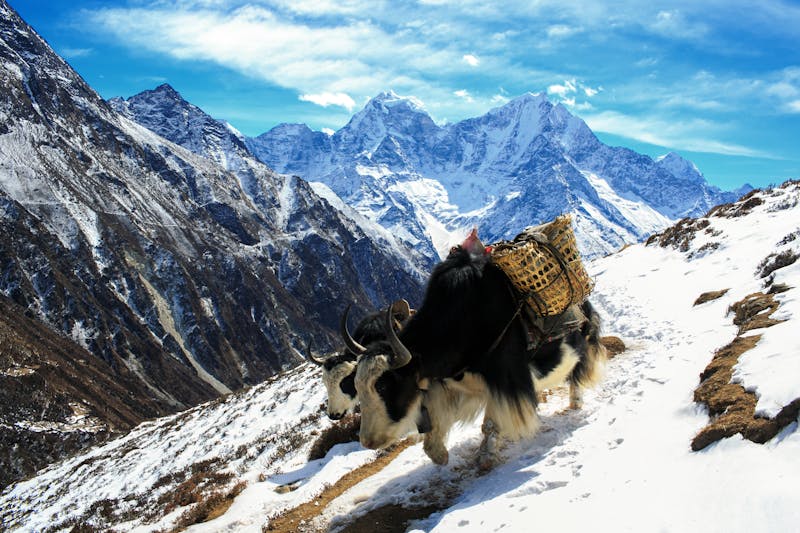
A traditional yak caravan on the ancient Nepal–Tibet salt trade route through Dolpa
For centuries, Dolpa sat at the crossroads of an ancient trade network linking Nepal, Tibet, and India. The Dolpo-pa people would lead yak caravans over mountain passes reaching 5,200–5,500 metres to trade barley and grain for Tibetan salt. This salt trade, once the lifeblood of the region, is one of the oldest continuous trading traditions in the Himalayas. While modern trade has reduced its scale, yak caravans still traverse these ancient routes today.
Upper Dolpa Contains Some of the World’s Highest Human Settlements
Villages such as Dho Tarap in Upper Dolpa rank among the highest permanently inhabited settlements on Earth. At altitudes that would leave most people breathless, communities here grow crops, raise yaks, and maintain rich cultural traditions. The altitudinal range of Dolpa District stretches from 1,525 metres at its lowest point to 7,625 metres at its peaks — a vertical world that encompasses tropical river valleys, high deserts, and glaciated summits within a single district.
Dolpa Inspired an Oscar-Nominated Film
The 1999 French-Nepalese film Himalaya (also known as Caravan), directed by Eric Valli, was entirely filmed in Dolpa — and became the first Nepalese film ever nominated for an Academy Award. The film portrayed the salt caravan tradition and the lives of the Dolpo-pa people, bringing global attention to this hidden corner of Nepal. Since its release, Dolpa has been on the bucket list of travellers, anthropologists, and cinema lovers worldwide.
A Special Permit Is Required to Enter Upper Dolpa
Dolpa is a restricted trekking area, and foreign visitors must obtain special permits to enter Upper Dolpa — currently costing USD $500 per person for the first 10 days, with additional fees thereafter. This intentional restriction keeps tourist numbers low, protecting the fragile ecosystem and preserving the region’s cultural authenticity. It also means that those who do make the journey experience something genuinely rare and unspoiled. Lower Dolpa, which includes Dunai and Phoksundo Lake, is accessible with standard trekking permits.
Dunai — The Gateway to All of Dolpa — Is Our Home
Dunai is the administrative headquarters of Dolpa District and the natural gateway to all the wonders described above. Situated at around 2,140 metres on the banks of the Thuli Bheri River, Dunai is where most Dolpa journeys begin and end. It is home to the Bala Tripura Sundari Devi Temple, local markets, the district government offices, and — most importantly — Hotel Murmur Garden Restaurant, your comfortable base for exploring everything Dolpa has to offer.
Ready to Experience Dolpa for Yourself?
Stay at Hotel Murmur in Dunai — the heart of Dolpa — and let us be your gateway to one of the world’s last great wildernesses. Book your stay directly via WhatsApp.
Book Your Stay Now